Are eSIMs safe for travel and everyday use?


eSIMs make it easy to stay connected while traveling or switching carriers. As with any change in mobile technology, it’s reasonable to ask how eSIMs handle security, tracking, and account protection.
This article breaks down how eSIM security works, where genuine risks exist, and whether eSIMs are safe for everyday use and travel.
What is an eSIM and how does it work?
An eSIM, which stands for embedded Subscriber Identity Module, is a built-in digital SIM card that lets your device connect to a mobile network without using a physical SIM. Instead of inserting or swapping cards, you download and manage cellular plans directly on your phone, making it easier to switch carriers, add data plans or additional phone numbers, or connect locally while traveling.
eSIM basics explained
Here’s how an eSIM works:
- Built-in chip: Your phone or device has a small, permanent chip called an embedded Universal Integrated Circuit Card (eUICC) that stores eSIM profiles from mobile carriers. It’s isolated from the OS, which makes direct tampering difficult.
- Digital activation: Instead of inserting a card, you activate a plan by scanning a QR code from your carrier, using their app, or through automatic setup.
- Profile download: Your carrier sends your account and network information, like your International Mobile Subscriber Identity (IMSI), to the eSIM chip digitally over an encrypted connection, programming it. eSIM profiles are protected by digital certificates.
- Network connection: Once programmed, the eSIM connects you to the network just like a physical SIM, handling calls, texts, and data.
eSIM security: What you need to know
eSIM technology doesn’t introduce new kinds of security risks on its own. Most security issues associated with eSIM use are related to device security, user accounts, or how mobile carriers manage numbers and profiles.
Can eSIMs be hacked?
eSIMs are difficult to hack directly because, like physical SIMs, they are isolated from the device’s OS. The OS can’t read, copy, or modify SIM credentials, which effectively removes most direct vectors of attack.
In practice, attacks usually target the phone or the user rather than the eSIM itself, such as through malware, phishing attempts that enable eSIM changes or activations, stolen account credentials, or social engineering.
SIM swapping and eSIMs
Carriers generally implement stronger verification steps before allowing an eSIM profile to be created or transferred, which helps reduce the risk of unauthorized SIM swaps. eSIM provisioning typically requires digital authentication directly on the device, such as confirming a QR code or using secure in‑app processes that only the legitimate user can authorize. Most carriers also require account authentication before making changes to your service, including multi-factor checks on the carrier account itself.
Because the eSIM profile is tied to the device’s hardware through carrier-controlled activation, it can’t be downloaded or activated on another device without proper authorization. Even if an attacker somehow convinces a carrier to issue a replacement profile, they would still need to complete the carrier’s activation process to set up the eSIM on a new device.
Can an eSIM be tracked or cloned?
eSIMs can be tracked through carrier-based tracking, where mobile network operators (MNOs) track all active SIMs (including eSIMs) to ensure network security, monitor service usage, and detect fraudulent activities. Location tracking through this method is done whenever your eSIM connects to a cellular network and registers with the nearest cell tower, allowing MNOs to approximate your location.
Researchers have shown eSIM cloning is technically possible by exploiting specific implementation flaws, but the attacks require physical access, deep technical expertise, and carrier‑specific credentials. These conditions make real‑world exploitation unlikely, and vendors have issued mitigations, so eSIM cloning is more of a theoretical or highly targeted risk rather than a common threat.
Trust and carrier security measures
eSIM carriers use many different strategies to secure their systems and protect customers. Some of them may include:
- Account authentication protocols: Carriers use strong login methods, such as multi-factor authentication (MFA), to prevent unauthorized access to your eSIM and account.
- Automated eSIM management: eSIM setup and activation are handled automatically, reducing errors and the chance of misconfigurations that could be exploited.
- Regular security audits: Systems are routinely checked for vulnerabilities, ensuring potential threats are identified and addressed quickly.
- Staff training and awareness: Carrier employees are trained to recognize phishing, social engineering, and other threats that could compromise eSIM security.
- Real-time activity monitoring: Carriers track unusual account changes or suspicious activity to detect and stop potential attacks early.
- Access controls and network segmentation: Critical systems are isolated and protected, limiting who can access sensitive eSIM data.
- Software and device updates: Firmware, software, and devices are regularly updated to protect against known security vulnerabilities.
These practices are shaped by industry-wide standards set by the Global System for Mobile Communications Association (GSMA), which defines how eSIM profiles are provisioned, managed, and secured.
Are eSIMs safe for banking and work accounts?
eSIMs don’t introduce new threats for banking or work accounts. However, many online services rely on two-factor authentication (2FA) using SMS-based verification codes, which can be vulnerable if that number is taken over through a SIM swap or port-out.
eSIMs reduce one common SIM swap risk because they’re embedded in the device and can’t be physically removed and inserted into another phone. This makes it harder for attackers to hijack your number without also compromising the device or your carrier account.
How to make your eSIM more secure
The proactive security measures below can help reduce your vulnerability to eSIM-related threats.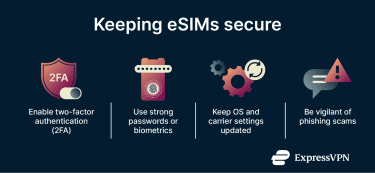
Enable 2FA
Using 2FA doesn’t secure your eSIM itself, but it does reduce the risk of account compromises that may lead to SIM swaps, port-out scams, or unauthorized eSIM changes.
Studies have shown that 2FA can dramatically reduce the amount of automated account takeover attacks, making it essential for security across all your accounts.
Use strong device passwords and biometric locks
Securing your devices from unauthorized access is critical to safeguarding your eSIM, which is why having a strong password or PIN is critical. Biometric locks are also a great alternative, as passwords and PINs can be guessed, but your biometrics are difficult to replicate. Consider using features like fingerprint unlock or Face ID for added safety.
Keep your OS and carrier profiles updated
It's important to keep the device's software up to date, as manufacturers often release security patches and updates to address vulnerabilities. Delaying important software updates can expose your device to security gaps that hackers may exploit.
Updating your carrier profile in a timely manner is also crucial, as it can ensure seamless connectivity and resolve any vulnerabilities or bugs that surface due to OS updates or configuration changes.
Watch for phishing attempts and port-out scams
Attackers may pose as a carrier, bank, or trusted service and attempt to trick you into sharing details such as account credentials or verification codes through unsolicited calls, emails, or messages.
Once attackers have this information, they may attempt a port-out scam or SIM swap by convincing your mobile network operator to transfer your phone number to a different device they control. This allows them to receive your calls and texts, including verification codes, so you should contact your carrier immediately if you suspect a phishing attempt.
Is it safe to use an eSIM with a VPN?
Yes, using a virtual private network (VPN) with an eSIM is completely safe. It can be an excellent security combination when traveling, as your eSIM provides cheap local data while a VPN encrypts your web traffic to prevent third parties from spying on your activity, which is especially important when using public Wi-Fi.
Some VPN providers, like ExpressVPN, also offer eSIM support with select subscription plans, allowing you to combine secure VPN connections with eSIM convenience when traveling.
FAQs: Common questions about eSIMs
What are the disadvantages of eSIM?
eSIMs have some limitations, one of which is device compatibility, because older smartphones might not have the hardware to use an eSIM. Transferring eSIMs between devices can also be more tedious, as there’s no physical SIM card that you can simply remove and insert into another device.
Can someone clone my eSIM?
Cloning an eSIM is extremely unlikely because the profile is stored in secure hardware and controlled by the mobile carrier. This means that there’s no practical way for attackers to copy the credentials they would need to duplicate them.
Can my eSIM be stolen or ported without permission?
It’s unlikely for eSIMs to be stolen in the traditional sense because, unlike physical SIM cards, no one can simply steal your phone and take out the SIM card to start using it. However, unauthorized port-outs or SIM swaps could happen if your carrier account is compromised or someone successfully impersonates you.
Are eSIMs safe for international travel?
eSIMs are generally very safe for international travel, but coverage can be limited in more remote regions. If your destination is not supported by your eSIM provider, you may need to rely on a local eSIM, which means your mobile traffic is handled by a local carrier and subject to local laws around data access, surveillance, and retention.
Is an eSIM safe if your phone is lost or stolen?
If your phone is lost or stolen, eSIMs are quite secure. Carriers can remotely deactivate your eSIM profile and issue a replacement, immediately cutting off access to your phone number. Since the eSIM can’t be removed from the device, it’s impossible to take the SIM and use it elsewhere, helping protect your identity and accounts once the loss is reported.
What should I do if my eSIM is compromised?
If you suspect your phone number or carrier account has been compromised, contact your mobile carrier to tell them you suspect fraudulent activity. They can suspend service remotely to prevent further misuse.
Next, consider changing passwords for crucial accounts like email, banking, and any others that are linked to your phone number for recovery. It’s also a good idea to notify your contacts that your phone number or accounts might be compromised.
Take the first step to protect yourself online. Try ExpressVPN risk-free.
Get ExpressVPN












 Support Center
  FAQ
FAQ  VPN Setup Tutorials