Expressvpn Glossary
AES encryption
What is AES encryption?
Advanced Encryption Standard (AES) is a symmetric block cipher that protects data by converting it into unreadable ciphertext. Adopted by the U.S. National Institute of Standards and Technology (NIST) to replace the now obsolete Data Encryption Standard (DES) in 2001, AES has become a global standard for securing data across industries and governments.
How does AES encryption work?
- Symmetric key cryptography: AES uses a single shared key for encryption and decryption. This means that both the data sender and receiver must have the same secret key to read the data.
- Key expansion and rounds: The algorithm expands the original key into multiple round keys. Each round applies a series of mathematical operations that mix and scramble the data. 128-bit AES uses 10 rounds, 192-bit AES uses 12, and 256-bit AES uses 14.
- Substitution–permutation network: AES operates on fixed 128-bit blocks and repeatedly scrambles it through a process of substitution (swapping bytes using a fixed table) and permutation (shuffling rows and mixing columns). These steps make it extremely difficult for anyone without the key to detect patterns or reconstruct the original data.
- Implementation in secure systems: AES is used in virtual private networks (VPNs) and network protocols to secure data in transit. Modern VPNs, like ExpressVPN, use 256-bit AES encryption to protect data. File and disk encryption tools and secure messaging applications also use AES.
Why is AES encryption important?
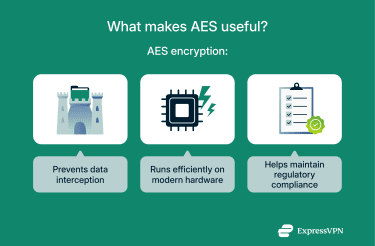 AES prevents unauthorized parties from viewing or tampering with your data, and it has never been practically cracked when implemented correctly.
AES is designed to run efficiently in both hardware and software. Modern processors include Advanced Encryption Standard New Instructions (AES‑NI) that accelerate encryption, which allows strong data protection with a minimal impact on performance.
Major data-protection standards like the Health Insurance Portability and Accountability Act (HIPAA) and the Payment Card Industry Data Security Standard (PCI-DSS) recommend using AES, and it’s trusted by governments, banks, healthcare providers, and consumer security tools like VPNs.
AES encryption key sizes
- 128-bit AES: The fastest version of AES, using a 128-bit key and 10 rounds of encryption. It provides strong security for most applications, but 256-bit AES offers greater safety.
- 192-bit AES: Uses a 192‑bit key with 12 rounds. It offers more security but slightly reduced performance due to the added encryption rounds.
- 256-bit AES: Employs a 256‑bit key and 14 rounds, providing the highest level of security. It’s often mandated in governmental, financial, and enterprise environments where maximum data protection is required.
AES encryption vs. RSA encryption
AES is a symmetric cipher that uses the same key for both encryption and decryption. The Rivest–Shamir–Adleman cryptosystem (RSA), on the other hand, is an asymmetric algorithm that uses a key pair: a public key and a private key. Typically, the public key encrypts data and the private key decrypts it, but in some cases, the private key is used to sign or encrypt data and the public key is used to verify or decrypt it.
When it comes to speed, AES is significantly faster than RSA, making it better suited for encrypting large volumes of data. RSA is slower and more computationally intensive, so it’s mainly used for smaller data sets, digital signatures, or for securely exchanging encryption keys.
AES is resistant to all known attacks and is widely used to protect data once both parties share a secret key. RSA, on the other hand, is often used to establish or exchange that key securely. In most modern systems, these algorithms are combined in what’s known as hybrid encryption, where RSA handles the key exchange and AES encrypts the data itself.
Common uses of AES encryption
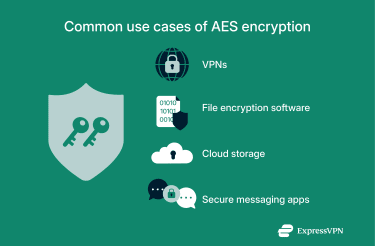
- VPNs and network traffic: AES is used to secure VPN connections and with encryption protocols like TLS/HTTPS.
- File and disk encryption: Full‑disk encryption tools such as BitLocker and FileVault use AES to protect data at rest.
- Cloud storage and transmission: Major cloud providers use AES to protect data in transit and at rest.
- Secure messaging: Messaging apps such as Signal and WhatsApp use AES to encrypt message content, ensuring that only the intended recipients can read messages.
Further reading
FAQ
What does AES stand for?
AES stands for Advanced Encryption Standard. It’s a symmetric encryption algorithm that was standardized by the National Institute of Standards and Technology (NIST) in 2001.
Is AES encryption secure?
Advanced Encryption Standard (AES) is considered highly secure and has undergone extensive testing and cryptanalysis. However, its real-world safety depends on how it’s implemented and used. Weak configurations or flawed integrations can still expose systems to attacks that indirectly compromise AES-based encryption. However, when implemented correctly, AES is one of the most trusted standards for protecting sensitive data.
What’s the difference between 128-bit AES and 256-bit AES?
The difference is key length and the number of rounds: AES‑128 uses a 128‑bit key and 10 rounds, while AES‑256 uses a 256‑bit key and 14 rounds. Governments and financial institutions mandate or recommend 256-bit keys.