Is Coinbase safe? A complete security guide before you buy, store, or transfer crypto


Coinbase is one of the most widely used crypto exchanges among beginners and experienced traders. It's often presented as a relatively "safe" platform, but that framing oversimplifies how crypto security works. The real question is which risks Coinbase helps reduce, which ones it can't prevent, and where responsibility falls on the user.
Please note: This article is for informational purposes only and doesn't constitute investment or financial advice.
What is Coinbase? A quick overview
Coinbase is a cryptocurrency exchange founded in 2012. It lets you buy, sell, store, and transfer digital assets like Bitcoin and Ethereum. The company went public in April 2021 and trades on the Nasdaq under the ticker COIN.
Coinbase operates in 100+ countries and reported $376 billion in platform assets and $1.2 trillion in annual trading volume as of December 31, 2025. Because these figures change over time, it helps to date them clearly.
It offers a custodial exchange account and a separate self-custody wallet product that follow different security models, especially around who controls the private keys. A private key is essentially a long, unique secret that proves control over crypto assets. Without it, those assets generally cannot be accessed.
Coinbase exchange vs. Coinbase Wallet
In crypto, whoever holds the private keys controls the funds. That's the core distinction between these two products.
- Coinbase exchange (custodial): The main platform for buying, selling, and managing crypto. Coinbase holds your assets and manages the private keys on your behalf, making the service more convenient. It also means Coinbase can often help you recover access to your account if you lose your login details.
- Coinbase Wallet (self-custody): A separate app where you control your own private keys and recovery phrase. Coinbase doesn't have access to those credentials, so it can't recover the wallet if you lose them.
A self-custody wallet can be a secure way to store crypto, but its safety depends heavily on how well you protect your recovery phrase and device.
Coinbase's security infrastructure
Coinbase uses a layered security model that combines offline storage, account-level protections, and transaction controls.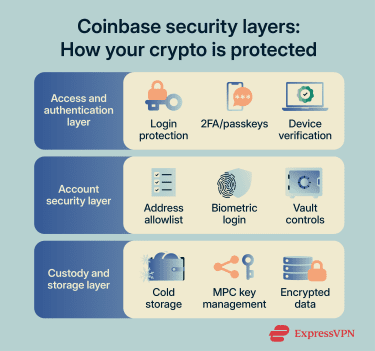
Cold storage and key management
A vast majority of customer assets are stored in cold storage, meaning the relevant private keys are kept offline. This reduces exposure to remote attacks.
Secure multi-party computation (MPC) is also used for digital-asset key management. In this model, cryptographic key material is split into shares so that the full key is never in one place at any given time, and transactions can be signed without bringing those shares together. This reduces the number of single points of compromise compared with traditional single-key storage.
Coinbase also encrypts stored bank account and routing numbers with Advanced Encryption Standard (AES)-256 on its servers, and that traffic between your devices and Coinbase is encrypted in transit.
Two-factor authentication
Coinbase requires two-factor authentication (2FA) to access an account and uses it for certain sensitive actions. It supports several verification methods, including hardware security keys, passkeys, authenticator apps, and SMS.
Hardware security keys and passkeys offer the strongest protection because they use phishing-resistant public-key authentication. Authenticator apps also provide strong protection. SMS-based verification is generally the least secure option and is more exposed to attacks such as SIM swapping.
Account-level safeguards
Coinbase includes several controls designed to limit unauthorized activity:
- Address allowlist: Lets you store trusted crypto addresses for safer transfers.
- Biometric login: In the Coinbase mobile app, you can enable PIN or biometric authentication, such as Face ID or fingerprint login on supported devices.
- Device verification: Coinbase may require email confirmation when a sign-in attempt comes from a new device or IP address.
- Coinbase Vault: Vault withdrawals can require multiple approvers, a time delay, or both. Coinbase help materials describe a 48-hour waiting period in common vault-withdrawal workflows.
These controls are designed to slow unauthorized activity and give you more time to respond if your account is compromised.
Insurance and financial protections: Scope and limits
Coinbase carries crime insurance that protects a portion of digital assets held across its storage systems against losses from theft, including those resulting from cybersecurity breaches.
However, the coverage is limited:
- It's designed for certain platform-level theft losses, not as a guarantee against every customer loss.
- The policy doesn't cover losses resulting from unauthorized access to a personal account caused by a breach or loss of credentials.
- For some Coinbase One members, a separate account-protection program may cover certain unauthorized outbound crypto transfers, but not transactions a user authorized, even if they were deceived.
Coinbase also states that it holds customer assets 1:1 and doesn't lend or take action with those assets unless the customer specifically instructs it to do so. This means customer assets are not supposed to be used as the company's general working capital in normal operations
Cryptocurrency is not protected by government deposit insurance schemes such as the Federal Deposit Insurance Corporation (FDIC). U.S. dollar balances held as cash at partner banks or credit unions may be eligible for pass-through protection, subject to applicable limits and conditions, but that does not extend to crypto assets.
Note: Coinbase itself is not an FDIC-insured bank; FDIC insurance only applies to the cash deposits held at the partner banks in the event of those specific banks' failure, not the failure of Coinbase.
Regulator compliance and public reporting
As a publicly listed company, Coinbase files reports with the Securities and Exchange Commission (SEC) and undergoes external audits of its financial statements and internal control over financial reporting.
In the U.S., Coinbase is registered as a money service business with the Financial Crimes Enforcement Network (FinCen) and holds money transmitter licenses where required at the state level. In the U.K., CB Payments, Ltd. is authorized by the Financial Conduct Authority (FCA) as an electronic money institution and registered under the Money Laundering Regulations for specific cryptoasset activities. In 2025, Coinbase announced it secured a Markets in Crypto Assets Regulation (MiCA) license from Luxembourg's Commission de Surveillance du Secteur Financier (CSSF), allowing it to offer crypto services across all 27 EU member states.
Where Coinbase protections are limited
Coinbase's security controls focus on protecting infrastructure and user accounts, but they don't cover all scenarios:
- Authorized transactions: Cryptocurrency transactions are generally irreversible by design. If a user authorizes a transfer or sends funds to the wrong address, Coinbase generally cannot reverse it. Limited asset-recovery options exist for some unsupported-asset errors, but they don't apply to all transfers.
- Attacks outside the platform: Coinbase cannot prevent every phishing, impersonation, or social engineering attack that occurs outside its systems. Accounts using SMS-based 2FA remain more exposed to SIM-swap attacks than those protected by stronger methods.
- Self-custody risks: For Coinbase Wallet users, losing a recovery phrase can mean permanent loss of access to funds. Coinbase also cannot reverse malicious or mistaken self-custody transactions.
Coinbase's privacy policy: What data it collects and shares
From a cybersecurity perspective, Coinbase's privacy policy matters because exposed or mishandled data can increase the risk of targeted attacks.
What Coinbase collects
Coinbase collects personal identification data, transactional information, and device details. This includes contact information, such as an email address and phone number, home address, date of birth, government-issued identification, and biometric information generated from photos or videos used for identity verification.
The platform also automatically collects technical data, including IP addresses, app, browser, and device information, and product-usage data such as what you view or click while using its sites and apps.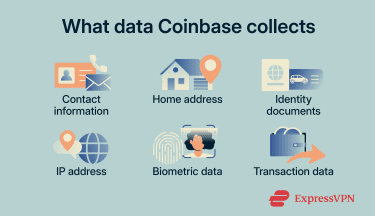
What it's used for
Coinbase uses this data for identity verification, processing transactions, fraud prevention, platform security, customer support, service improvement, and compliance with legal and regulatory obligations. As a regulated financial service, it collects and processes some personal information to determine eligibility for certain products and to respond to valid regulatory and law-enforcement requests.
It also keeps some personal information for at least five years, even after you've closed your account, to comply with legal obligations or protect its interests. Depending on the jurisdiction, you may have rights to access, correct, delete, restrict, or object to some processing through Coinbase's Privacy Rights Dashboard or support channels.
Who it's shared with
Coinbase shares user data with affiliates, trusted third-party service providers, and, where applicable, regulators, law enforcement authorities, and government agencies. Coinbase says it doesn't sell customers' personal information. It does, however, share conversion data, including IP addresses, with advertising partners such as Meta and AppLovin to create custom audience lists. You can opt out of advertising-related data sharing through the Privacy Rights Dashboard.
According to the company's 2025 Transparency Report, 12,716 law-enforcement requests were received during the reporting period, and each one was reviewed for legal sufficiency.
Common scams targeting Coinbase users
Many losses involving Coinbase stem from scams or account compromise rather than failures of its core infrastructure. These scams are not unique to Coinbase and target users across major exchanges and financial platforms.
- Technical support impersonation: Fraudsters call or text, posing as Coinbase Support and claiming an account is compromised. They may ask for 2FA codes, passwords, or for funds to be moved to a "safe" address they control. They may also ask for software to be installed or for remote access to a device, which can give them access to the account and other sensitive information.
- Phishing: Attackers send fake Coinbase emails or texts claiming that an account has been suspended or that there's been an unauthorized withdrawal attempt. The message links to a fake website designed to steal login credentials or 2-step verification codes.
- Address poisoning: As with other well-known crypto platforms, attackers may try to exploit wallet history by sending a small transaction from an address that closely resembles a previously used one. If funds are later sent by copying an address from transaction history without careful verification, they may go to the attacker's address instead of the intended one.
- Rug pulls: Some crypto projects collapse after developers collect investor funds and abandon the project, leaving behind worthless or near-worthless tokens. These schemes typically rely on hype, misleading promotion, or fake endorsements, posing a broader risk to the crypto market rather than being specific to Coinbase.
- SIM swap attacks: Scammers may convince a mobile carrier to transfer a victim's phone number to another device, allowing them to intercept SMS-based authentication codes. This is one reason SMS-based 2FA is considered weaker than phishing-resistant options such as passkeys or security keys.
- Recovery scams: Fraudsters may target people who have already lost funds by posing as recovery services, investigators, or law enforcement and promising to retrieve the assets for an upfront fee.
- Wallet-related scams: Users may be tricked into sharing recovery phrases or into approving a connection to a malicious website, smart contracts, or app. These scams can give attackers access to wallet assets without any breach of Coinbase's core systems.
Coinbase states that its support teams will never ask you for login credentials, 2FA codes, a seed phrase, software installation, or remote access to a device. The company is also part of the Tech Against Scams coalition with Kraken, Gemini, GASO, Ripple, Meta, and Match Group, whose members share threat intelligence and best practices to combat scam networks targeting users across platforms.
How to protect your Coinbase account
The safety of your crypto depends on both Coinbase's security infrastructure and the security of the account itself.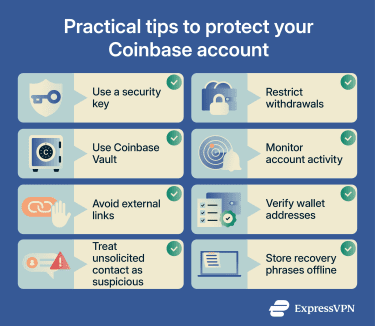
The following security practices can make a significant difference:
- Use phishing-resistant authentication: Switch from SMS codes to an authenticator app, or better still, a hardware security key or passkey. Hardware security keys and passkeys are phishing-resistant because they use public-key authentication tied to the legitimate site or app. Tools like ExpressKeys can help you store and manage passkeys securely.
- Enable withdrawal allowlisting: Limit withdrawals to trusted wallet addresses where possible. It's recommended that you enable withdrawal allow-listing so that transfers go only to wallets that are known and trusted.
- Use Coinbase Vault for long-term holdings: Vault can add time-delayed withdrawals and multiple approvals, which can limit how quickly funds are moved if an account is compromised.
- Avoid external links: Access Coinbase directly through its official website rather than via links in emails, texts, or ads. This also helps reduce the risk of typosquatting, where attackers use lookalike domain names to mimic legitimate sites.
- Verify wallet addresses before sending: Double-check the destination address before confirming a transaction. This can help reduce the risk of sending funds to the wrong address or to a lookalike address used in an address-poisoning scam.
- Treat unsolicited contact as suspicious: Coinbase will never ask for account access, passwords, 2-step verification codes, software installation, or transfers to a "safe" address. Unexpected calls, texts, or messages that create a sense of urgency about an account should be treated with caution.
- Store your recovery phrase offline: Back it up, since losing it can mean losing access to the wallet and its assets. Keeping your recovery phrase offline reduces the risk of online compromise.
FAQ
Does Coinbase insure your crypto?
Can Coinbase freeze or lock your account?
What's the difference between Coinbase and Coinbase Wallet?
What happens if Coinbase goes bankrupt?