Expressvpn Glossary
IP network
What is an IP network?
An IP network is a communication system that uses the Internet Protocol (IP) to identify devices and route data between them. It enables devices to exchange information across local and global networks.
Each device connected to the network is assigned a unique IP address, which ensures data is delivered to the correct destination.
How does an IP network work?
An IP network transmits data by dividing it into small units called IP packets. Each packet contains a source and destination IP address.
Routers examine the destination IP address and forward packets toward the appropriate network. Packets may take different paths and pass through several routers before being reassembled at the destination device.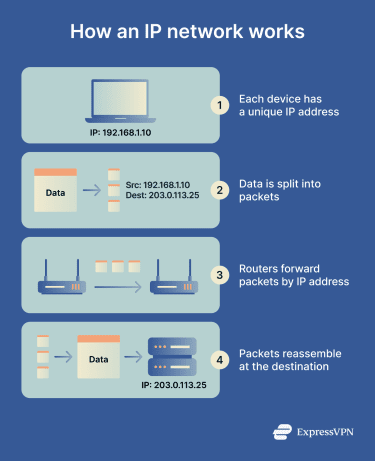 Large IP networks are divided into subnets to organize devices and manage traffic more efficiently.
IP addresses
Every device on an IP network requires a unique IP address. The two types in use are Internet Protocol version 4 (IPv4) and Internet Protocol version 6 (IPv6). The main differences are address space and format.
| Feature | IPv4 | IPv6 |
| Address size | 32-bit | 128-bit |
| Address space | 4.3 billion | 3.4 × 1038 |
| Format | Dotted decimal (192.168.1.1) | Hexadecimal (2001:0db8:0000:0000:0000:ff00:0042:8329) |
Types of IP networks
IP networks can operate at different scales and for different purposes.
| Network type | Scope | Access | Typical use case |
| Local area network (LAN) | Limited area, such as a home or office | Private | Connecting local devices such as computers and printers |
| Wide area network (WAN) | Connects multiple LANs across larger geographic areas | Private or public | Linking offices in different locations |
| Virtual private network (VPN) | Overlay network that operates over another IP network | Private and encrypted | An encrypted tunnel that routes traffic through a remote server, masking the user’s original IP address |
| Internet | Global system of interconnected public IP networks | Public | Accessing websites and online services |
Why are IP networks important?
IP networks provide a standardized framework for device-to-device communication. Because IP is an open standard and widely adopted, networks built and operated by different organizations, using different hardware and software, can interoperate without custom integration.
Packet-based communication also supports scalability. New devices and subnets can be added without redesigning the entire network. This flexibility underpins internet access, cloud computing, enterprise networking, and mobile data services.
Where are IP networks used?
IP networks are used in both consumer and enterprise environments, for example:
- Wi-Fi and LANs: Connecting devices within a local network.
- Internet access: Routing web and application traffic between end users and servers.
- Cloud computing: Supporting remote data storage and distributed computing.
- Voice services: Carrying Voice over Internet Protocol (VoIP) communication.
- Remote work: Providing access to internal systems over VPNs and WANs.
- Mobile networks: Assigning IP addresses to devices connected via cellular data.
Risks and limitations of IP networks
IP networks introduce security and operational risks:
- Security vulnerabilities: IP addresses function as unique identifiers that, if exposed, enable attackers to track locations and target specific devices.
- Data privacy exposure: Public IP addresses can reveal approximate geographic locations and browsing habits, raising privacy concerns.
- Cyberattacks: IP addresses are prime targets for distributed denial-of-service (DDoS) attacks, which flood networks with traffic, severely disrupting services.
- IP spoofing and hijacking: Attackers can impersonate legitimate devices by falsifying their IP address (spoofing) or redirect traffic to fraudulent networks (hijacking), compromising data integrity.
- Metadata exposure: Even when content is encrypted, metadata such as connection times and endpoints can remain visible.
Further reading
- Types of IP addresses explained: Complete guide
- IPv4 vs. IPv6: Which one is better?
- What are IP address classes? Importance for VPNs and cybersecurity
- Are we running out of IP addresses? 5 facts to know