Expressvpn Glossary
Internet bot

What is an internet bot?
An internet bot is a software program that automates tasks across websites and online services. It follows predefined instructions to perform actions such as scanning webpages, responding to messages, or submitting forms without direct human input.
How does an internet bot work?
A bot works by sending automated requests to websites, apps, or application programming interfaces (APIs), which allow software systems to communicate and exchange data. It runs based on instructions defined by its developer. These instructions specify what data to request, what actions to perform, and how to respond to the results.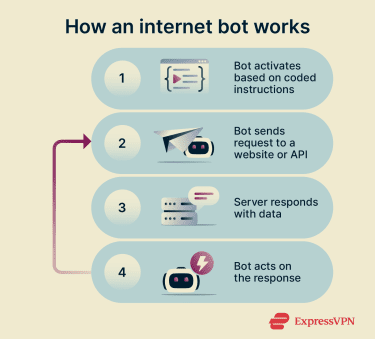 Most bots follow a repeated cycle. They send a request, receive a response, and then act on it based on predefined rules. That action might involve extracting data, posting content, following a link, retrying the request, or moving to the next task. This cycle can run continuously without direct human input.
Types of internet bots
There are various types of bots; some are legitimate, while others can be used maliciously:
- Search engine crawlers: Follow links between webpages to collect and index content. Search engines rely on this data to return relevant results.
- Chatbots: Simulate conversation through a messaging interface, usually on a website or app. Common uses include answering support questions and directing users to the right place.
- Monitoring bots: Track systems or websites for changes such as downtime, performance drops, or security events. Alerts are triggered when issues are detected.
- Scraper bots: Pull specific data points from websites, such as product prices or contact details. Some uses are legitimate, but they can also involve collecting personal data in a way that may violate site policies.
- Credential stuffing bots: Test username and password pairs from data breaches across other services. This takes advantage of password reuse to gain unauthorized access.
- Spambots: Collect email addresses to send unsolicited messages. They may also create fake accounts on websites or platforms to post spam or send messages at scale.
Why are internet bots important?
Bots power search engine results and useful internet automation. They also support search and customer service and help with network or system monitoring and threat detection.
On the other hand, bots can serve malicious purposes, including collecting login credentials through phishing, spreading spam, or generating large volumes of fake traffic.
Bots make up a large share of web traffic, which means a noticeable portion of activity on many websites is generated by software rather than human users. For businesses, this can affect how traffic data is interpreted and how systems are designed. Metrics such as visits, clicks, or sign-ins may include automated activity, and systems like login pages or APIs need to handle repeated, high-volume requests.
Risks and privacy concerns
- Data harvesting: Bots can scrape personal information from public profiles or user-generated content. This data may be sold, used for targeted phishing, or fed into further automated attacks.
- Account compromise: Credential stuffing bots test username and password combinations from data breaches across other services. When passwords are reused, this can lead to unauthorized access on multiple accounts.
- Inflated analytics: Bot-generated traffic can distort metrics such as pageviews and click rates. Businesses acting on this data may make decisions based on activity that doesn’t reflect real users.
Further reading
- Everything you need to know about bots
- IoT botnets explained: How to detect and defeat them
- Data scraping: What it is and how it works