Expressvpn Glossary
Dedicated IP

What is a dedicated IP?
A dedicated Internet Protocol (IP) address is an address assigned to a single user, organization, or account rather than shared among multiple customers. It typically remains the same across connections and restarts, although it may still change if the provider reallocates addresses during service or account changes.
Dedicated IPs are commonly offered by internet service providers (ISPs) for fixed customer addresses and by virtual private network (VPN) services as a consistent exit address tied to a subscriber’s account.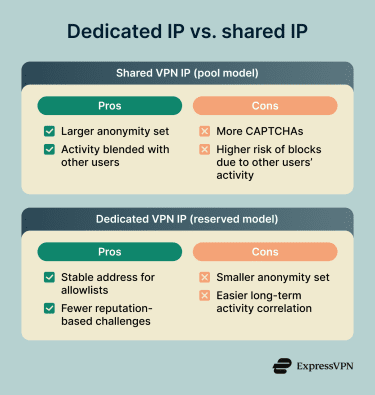
How does a dedicated IP work?
In a VPN context, a VPN provider that offers a dedicated IP address reserves one address and assigns it to a specific subscriber account. When the subscriber connects, the VPN creates an encrypted tunnel to the provider’s server and routes traffic through that tunnel.
The same dedicated address is used as the exit IP address for each session, so external services see a consistent source address. Data sent through the tunnel remains encrypted in transit between the client and the VPN server.
Where is a dedicated IP used?
A dedicated IP is commonly used for corporate access because some control panels, firewalls, Software-as-a-Service (SaaS) platforms, and remote access tools accept only predefined or allowlisted addresses.
It's also used for SaaS administration and personal servers, where platforms or self-hosted services may require, or benefit from, a fixed IP address for reliable access.
Additionally, some business platforms and other sensitive services restrict access to fixed, allowlisted IP addresses as an added security control.
Benefits of a dedicated IP
- Predictable connectivity: A fixed address supports consistent connections and can simplify authentication and allowlisting.
- Potentially fewer CAPTCHAs and fraud checks: Shared IPs can accumulate a poor reputation from other users’ activity, which may lead to more CAPTCHA challenges or extra fraud screening. A dedicated IP can reduce these reputation-based issues, though it doesn't prevent them entirely.
- Lower risk of shared blocklisting: A single-account address avoids reputation penalties stemming from other users’ behavior on a shared IP address.
- Simpler firewall management: Allowlists require fewer updates when the address does not change.
Risks and limitations
- Reduced privacy: A stable address can make activity easier to link across sessions and support long-term profiling.
- Higher cost: Dedicated addresses typically cost more, partly due to IPv4 scarcity.
- Persistent tracking: Reuse of the same address can make correlation over time easier.
Further reading
- How our dedicated IP maintains anonymity
- Static IP vs. dynamic IP: Key differences, and which one you need
- How to set up a static IP address (step-by-step guide)
- Types of IP addresses explained: Complete guide
- Who owns an IP address and how a VPN keeps yours private
FAQ
What’s the difference between a dedicated IP and a shared VPN IP?
Does a dedicated IP mean I’m no longer private?
Can a dedicated IP help with CAPTCHA?
Is a dedicated IP the same as a static IP from my ISP?
The main difference is the context and what network the address represents (the customer connection versus a service’s exit or hosted endpoint).