Expressvpn Glossary
Datafication
What is datafication?
Datafication is the process of quantifying aspects of human life and converting them into trackable data. Once collected, this data can be analyzed to identify patterns, predict future trends, understand consumer preferences, and generate scores or performance metrics used to evaluate individuals or behaviors.
How does datafication work?
Datafication begins when a user interacts with a device or digital service and continues as that interaction is recorded, processed, and analyzed.
It typically starts with data capture through apps, websites, and Internet of Things (IoT) sensors that record events as they happen.
The raw data is often sent to cloud storage, where it’s cleaned by removing incomplete or corrupt entries. It’s then preprocessed, meaning it’s converted into formats suitable for analysis or machine learning (ML).
Next, data analytics platforms or AI systems analyze these datasets to identify patterns and may infer characteristics like consumer preferences, purchasing power, or interests. These insights can influence decisions like which ads a user sees or what prices or offers are shown.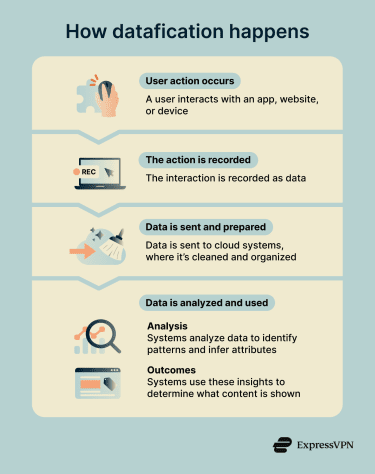
Why is datafication important?
Datafication drives many influential systems today. Social media platforms like Facebook and X collect behavioral data to personalize content, while platforms like Uber use user data for traffic analysis and usage patterns, helping them set surge pricing and optimize driver allocation.
These same techniques also power large-scale advertising ecosystems. For example, datafication enables systems where information about a user’s device, browsing context, and inferred interests can be shared with advertising platforms. Through a process called Real-Time Bidding (RTB), automated auctions occur in milliseconds to determine which ad will be displayed to a user.
Where is it used?
Datafication is used across many areas of modern life. Here are some key examples:
- Social media: Platforms track what users interact with and use the information to rank content and target ads.
- Shopping: Retailers analyze browsing and purchase history to personalize recommendations and adjust pricing.
- Wearables: Fitness trackers collect heart rate, sleep, and health data that can be used to provide personalized feedback on improving health.
- Finance and insurance: Banks and insurers use data like market trends and transaction data to assess risk.
Risks and privacy concerns
Datafication raises various privacy concerns, including:
- Pervasive tracking: Platforms can track users across different websites and apps, often using cookieless methods that are difficult to detect or block.
- Re-identification: Even “anonymized” data can sometimes be traced back to individuals.
- Data breaches: Centralized sources where data is processed during datafication become high-value targets.
- Manipulation: Vast quantities of data can enable manipulation via targeted messaging.
- Discrimination: AI systems built on datafication can reinforce existing societal biases, and feedback loops can compound this over time.
Further reading
- Protect your privacy: A guide to data removal services
- What is the IoB? Meaning, examples, and privacy impact
- Data harvesting: What it is and how to stay protected
- What are data brokers? Guide to your privacy and protection
- How to remove yourself from data broker sites
- What are trackers? Understanding how they affect your online privacy